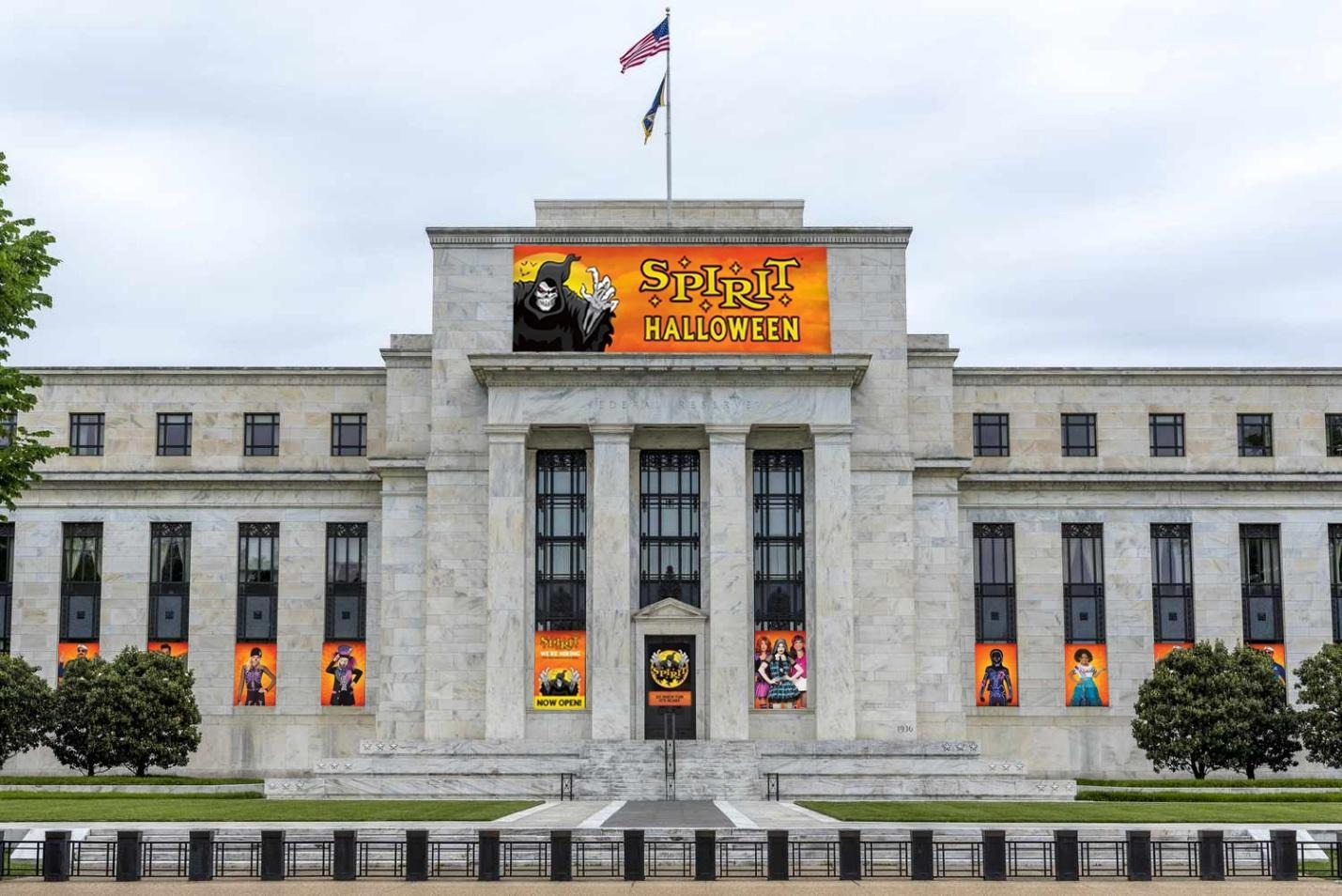
The estimated costs of the Fed’s building renovation project have risen from $1.9 billion to $2.5 billion. Hilariously, the Fed admits that one of the factors for the revised costs is “differences over time between original estimates and actual costs of materials, equipment, and labor.” Translation: “Looks like we’re not so good at forecasting and stabilizing future price inflation.”
At this point, extravagant government boondoggles are barely newsworthy. A few people batted their eyelashes last week at Trump’s proposal to expand military funding by half a trillion dollars but everyone has forgotten about it now because it was last week and attention spans are measured in seconds these days.
But the Fed’s building renovations are causing more of a stir. Senator Tim Scott questioned Powell about it last June, and now the Department of Justice has issued subpoenas about Powell’s answers. Powell responded with an uncharacteristically blunt message, saying that the DOJ’s actions are a pretext—that this is all a part of a plot, led by Trump, to diminish Fed independence in its monetary policy decisions.
Of course, Fed independence is a myth—a joke, really—as Ryan McMaken ably demonstrates:
The Fed is many things, but a servant of the common man or “the public” is not one of them. Central banks exist to keep borrowing costs low for governments, and to augment government revenue by extracting more wealth from the population in the form of the inflation tax. The idea that central bankers pore over economic reports to dispassionately determine the “best” policy for “the public” is pure propaganda.
Historically, the idea that the Fed is an apolitical data-driven institution has been disproven so many times it’s difficult to keep count. Over the past century, there are countless cases of the Fed explicitly working to facilitate wartime spending and welfare-state spending by monetizing the federal debt. More recently, in the wake of the Great Recession, the Fed bought up trillions of dollars worth of mortgage-backed securities to bail out billionaire bankers. The Fed now holds trillions in government securities to assist politicians with even more deficit spending, even as the total national debt approaches $40 trillion.
(See also my take on the event that allegedly established Fed independence, and Joe Salerno’s piece on how to reform the Fed. Murray Rothbard also demolished this myth.)
So the Fed is doing some expensive renovations, but why should taxpayers care? The Fed, after all, is “self-financed”! Consider this representative reporting from Fox Business:
The Fed is self-financing and does not rely on congressional appropriations to cover its operating expenses, which include employee salaries, facilities maintenance and the current renovation. Its primary income comes from interest earned on government securities and fees charged to financial institutions.
The true part of this statement begins with the sixth word, but then ends on a misleading note; the blatantly false part is that the Fed is “self-financing.”
The Fed does not rely on congressional appropriations. This is because it relies on conjuring up new dollars to purchase government securities, and then earns the interest on those securities. These interest payments from the Treasury ultimately come from—you guessed it—the taxpayer. In 2024, the interest income from its Treasury securities and other government debt was $153 billion.
But the Fox Business article also mentions “fees charged to financial institutions.” In 2024, this was $524 million (included in the Fed’s “Income from services” in its financial statements). That’s 0.34 percent of the Fed’s interest income from government debt—a drop in a bucket. So, including this in a list of how the Fed “self-funds” itself with equal (or, at least, unqualified) importance as its interest income is disingenuous. It gives the impression that the Fed earns a good chunk of its income by providing valuable check clearing services and automated clearing house operations to private financial institutions.
Even if this source of funds was significant for the Fed, it’s dubious that this should be considered honest income. The Fed is a government-privileged banking cartel, established by law. It’s not like they are truly competing on the market with private firms.
The propagandistic rhetoric surrounding the Fed’s “self-financing” makes it seem like the Fed can just snap its fingers and new building materials and labor appear out of thin air for its building renovations. We should remember the wise words of Frédéric Bastiat:
The State opens a road, builds a palace, straightens a street, cuts a canal, and so gives work to certain workmen — this is what is seen: but it deprives certain other workmen of work — and this is what is not seen.
The road is begun. A thousand workmen come every morning, leave every evening, and take their wages—this is certain. If the road had not been decreed, if the supplies had not been voted, these good people would have had neither work nor salary there; this also is certain.
But is this all? Does not the operation, as a whole, contain something else? At the moment when M. Dupin pronounces the emphatic words, “The Assembly has adopted,” do the millions descend miraculously on a moonbeam into the coffers of MM. Fould and Bineau? In order that the evolution may be complete, as it is said, must not the State organize the receipts as well as the expenditure? must it not set its tax-gatherers and tax-payers to work, the former to gather and the latter to pay?
Study the question, now, in both its elements. While you state the destination given by the State to the millions voted, do not neglect to state also the destination which the tax-payer would have given, but cannot now give, to the same. Then you will understand that a public enterprise is a coin with two sides. Upon one is engraved a laborer at work, with this device, that which is seen; on the other is a laborer out of work, with the device, that which is not seen.
In other words, when the Fed renovates its building in Washington, DC, the building materials and laborers have an opportunity cost. This opportunity cost is the value of their alternative uses, where and how they would have been used in the private market economy, subject to the profit and loss test of the market (i.e., subject to consumer demands).
The Fed is not “self-financed.” It is a legal counterfeiter—a particular kind of counterfeiter that uses new money to lend to the government (through primary dealer middlemen, in a sort of shell game). The new money is used to bid up prices throughout the economy, meaning ordinary citizens pay this “inflation tax” at the gas pump, grocery store, and everywhere else. When the Fed spends its interest income, which came from taxpayers, it bids resources and employment away from where it would have been used to serve consumers.
Thus, we should look upon the Fed’s luxurious amenities with contempt, the same way we’d look upon a counterfeiter’s mansion, or a car thief driving off with our car we bought with money we earned honestly.
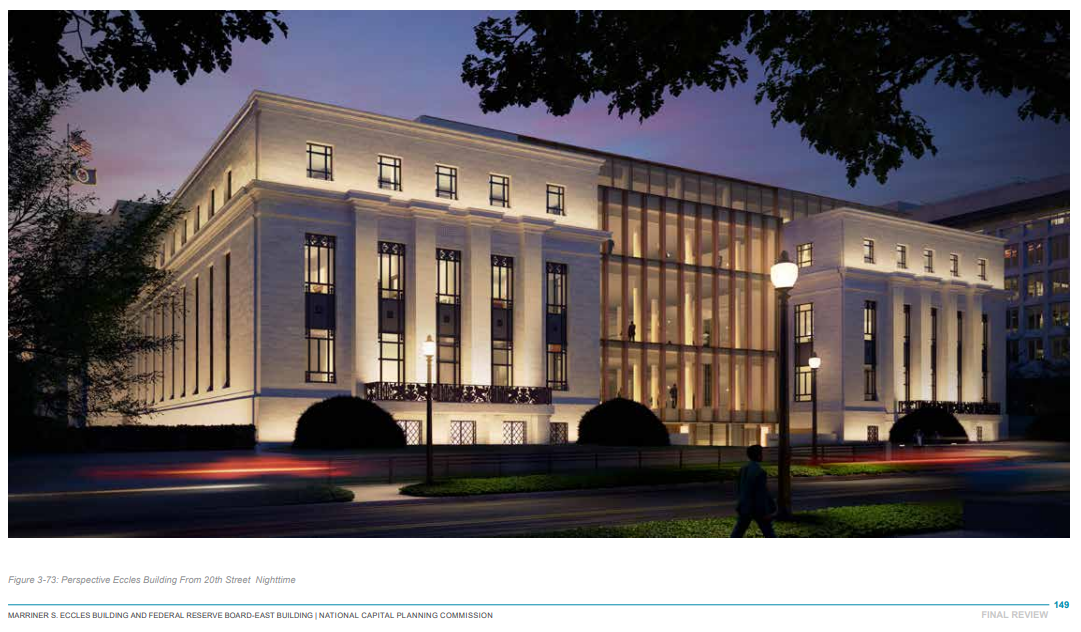
You can look at the 2021 plans for their building renovation yourself. While some of the details may have been eliminated or explained away after the political firestorm, these original plans included:
- A “Governors’ private elevator” to the executive dining suite (p. 37). Senator Tim Scott pressed Powell on these elevators, describing them as “new elevators that drop board members off at the VIP dining suite” and citing the page number. Powell responded that this is “just flatly misleading” and that “some of those are no longer in the plans,” referring to other things Scott listed, like rooftop terraces and ornate water features. Scott then asked if the plans changed because of the media attention, but then ran out of time, so Powell didn’t respond.
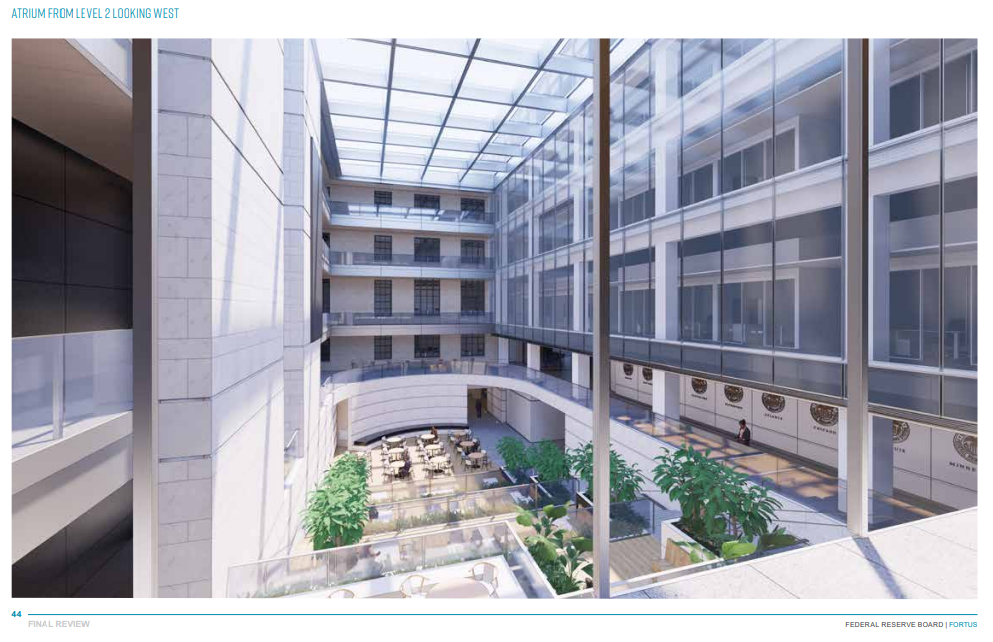
- An atrium VIP entrance, pictured below, with skylights in a “very calm, almost ethereal square grid with large format glass,” with “twelve equal spaces in salute of the Federal Reserve’s branch banks. Each branch bank will be recognized with their name engraved in glass panels” (p. 34).
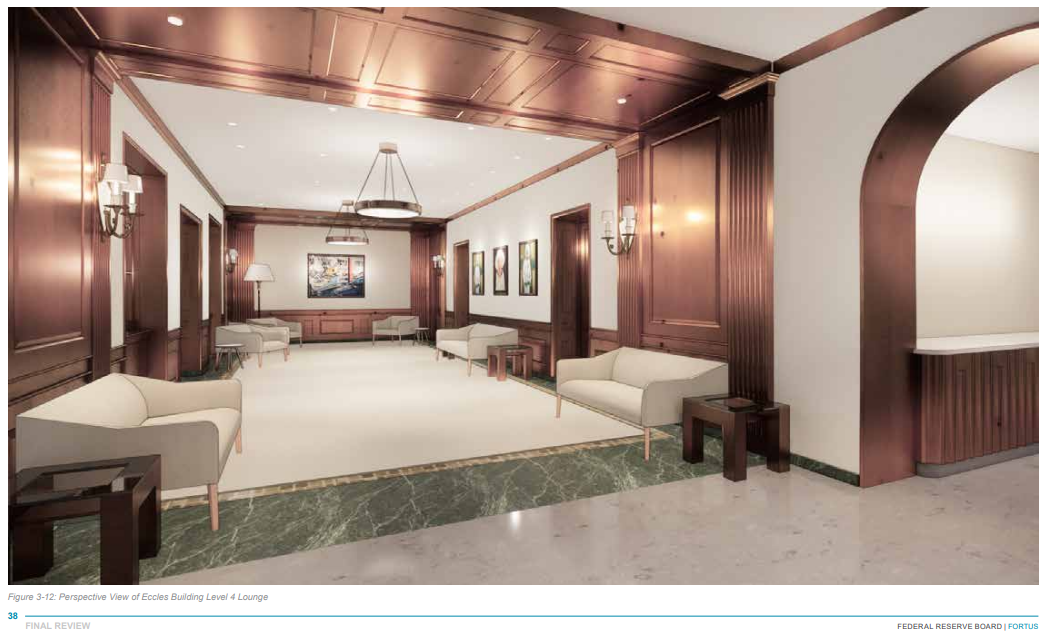
- Luxurious lounges, pictured below.
In my opinion, the renovations should look like this: